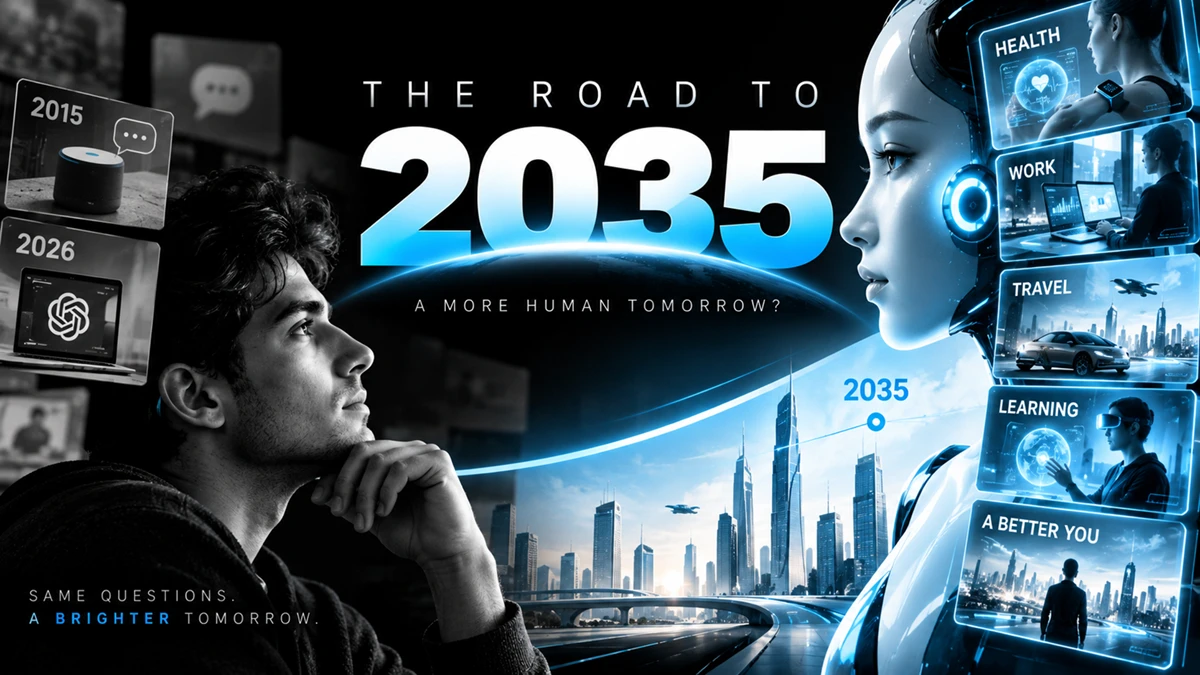
Then vs. Now vs. 2035
1. AI Woven Into Everyday Life
Today's smart assistants respond to commands. By 2035, AI personal assistants will anticipate needs before we articulate them — understanding context, mood, and history with something close to human intuition. Wearable AI will continuously learn our habits, quietly nudging us toward better health, sharper focus, and steadier work-life balance.
The bigger shift is in decision support. Holiday planning, tax filing, even early-stage legal or medical questions — AI will handle the groundwork, leaving humans to make the final call with far better information in hand.
2. Healthcare Reimagined
Healthcare may see the single biggest transformation of any sector. AI already assists in diagnostics and treatment planning — by 2035, predictive disease modeling will flag health risks before symptoms even appear, drawing on real-time data from wearables and full patient histories.
3. Autonomous Transport and Smart Cities
Roads by 2035 will run on a mix of self-driving cars, trucks, and public transit, cutting accidents and congestion dramatically. Smart cities will coordinate with these vehicles in real time — optimizing traffic flow, energy use, and public safety as one connected system.
The Smart City AI Layer
All four systems share one predictive AI backbone, reacting to real-time city-wide data.
4. Education and Work, Redesigned
AI-driven education will adapt to each student's pace and style, making immersive virtual classrooms globally accessible. The goal by 2035 isn't just efficiency — it's an education system built around lifelong learning, keeping pace with a job market that's constantly shifting.
At work, AI will absorb the repetitive and mundane, freeing people for creative and strategic work. That shift raises the value of distinctly human skills — creativity, judgment, and emotional intelligence become the new competitive edge.
5. Ethical AI and Governance
As AI becomes deeply embedded in daily life, questions of ethics and oversight move from theoretical to urgent. By 2035, expect established global standards around transparency, accountability, and responsible use — shaped by ongoing debate over privacy and data security.
6. The Rise of AI Creativity
AI already composes music and drafts text. By 2035, that capability extends fully into film, design, fashion, and architecture — not replacing human creators, but collaborating with them to produce work neither could make alone.
7. Human-AI Collaboration
The defining relationship of the next decade isn't competition — it's collaboration. AI handles data analysis, scenario modeling, and pattern recognition at a scale humans can't match, freeing people to focus on judgment, direction, and meaning.
In medicine, engineering, and scientific research, this partnership compounds into real breakthroughs — accelerating progress on problems like climate change and space exploration that no single discipline could solve alone.
Seven Shifts Defining 2035
Frequently Asked Questions
Will AI actually replace most jobs by 2035?
Unlikely in the way it's often feared. AI will absorb repetitive and rule-based tasks, but roles requiring judgment, creativity, and emotional intelligence are expected to grow in value, not disappear.
Is predictive healthcare realistic within this timeframe?
Yes — the underlying technology (wearables, real-time data analysis, pattern recognition) already exists. The main constraints are regulatory approval and healthcare infrastructure catching up, not the AI itself.
Who decides the ethical rules AI will operate under?
This is still being shaped. Expect a mix of government regulation, international standards bodies, and industry self-governance — likely uneven across countries, at least initially.
None of this happens automatically — every one of these shifts still depends on how responsibly we build and deploy the systems behind them. The upside is real, but so is the work of getting privacy, fairness, and accountability right along the way. Which of these changes excites you the most, and which one worries you? Let us know in the comments.



Discussion (0)
Leave a Reply
No comments yet. Be the first to start the discussion!