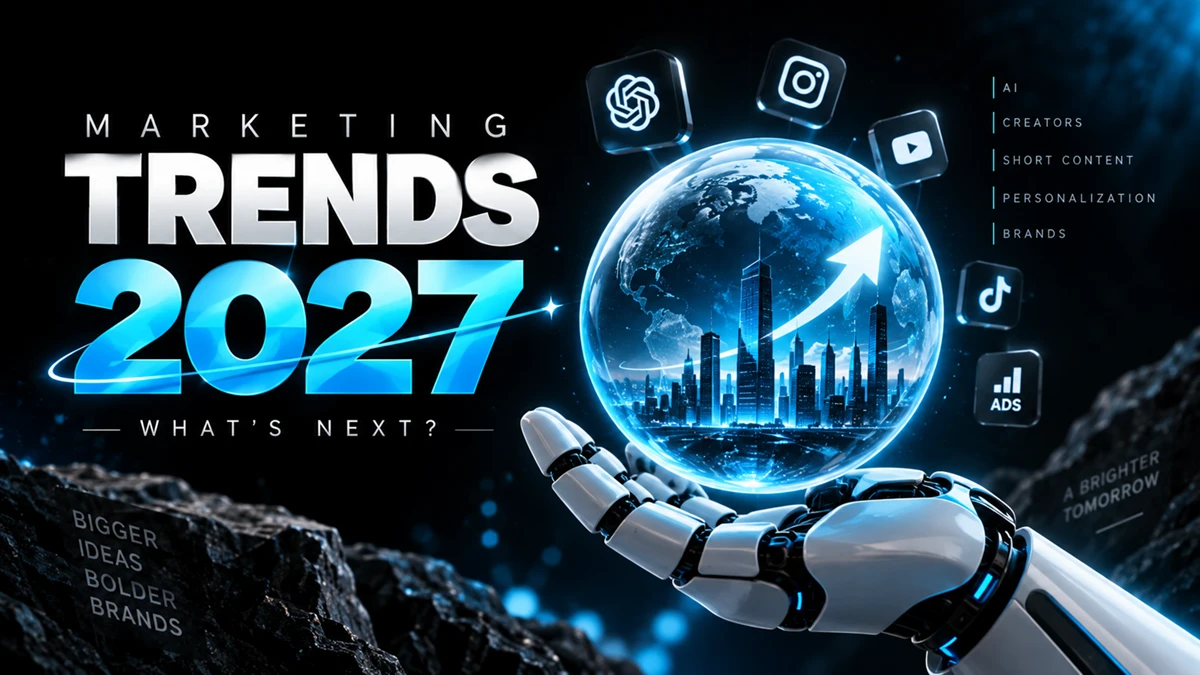
The Marketing Trends Actually Shaping 2027 — And How to Build Around Them
Key Takeaways
- Agentic AI now runs entire campaign loops — not just ad targeting, but optimization, creative testing, and reporting.
- AI-native search (ChatGPT, Perplexity, Google AI Overviews) has overtaken voice search as the SEO battleground.
- Short-form video has split into two lanes: raw creator content and AI-assisted premium brand video.
- Privacy-first personalization is now table stakes, not a compliance checkbox.
- Spatial and AR experiences are moving from novelty to normal for product marketing.
1. Agentic AI: From Automation to Autonomous Campaigns
In 2024, AI marketing meant smarter ad targeting and chatbot support. By 2027, it means autonomous agents that plan media buys, generate creative variants, run A/B tests, and reallocate budget in real time — with a human approving direction, not clicking every button.
The shift is from "AI-assisted" to "AI-run, human-directed." Brands that still treat AI as a single-purpose tool (just for ad copy, or just for analytics) are leaving most of the value on the table.

2. AI-Native Search Is the New SEO Battleground
Voice search optimization was the big story a few years ago. The bigger story now is AI-native search — ChatGPT, Perplexity, and Google's AI Overviews answering questions directly instead of sending users to a list of links. Ranking on page one means nothing if the AI answer never mentions your brand.
This has created a new discipline: Generative Engine Optimization (GEO) — structuring content so AI models cite and recommend you, not just so search bots crawl you.
Infizy audits client content specifically for GEO readiness — structuring pages so AI models can extract and cite them confidently, while keeping traditional SEO fundamentals intact.
3. Short-Form Video Splits Into Two Lanes
Reels, Shorts, and TikTok are still dominant, but the content itself has forked. One lane is raw, unpolished creator-style video built for the algorithm. The other is AI-assisted premium short-form — brand films compressed into 15-30 second cuts using AI-driven editing, voice, and motion graphics.
Brands that only play in one lane are missing reach in the other. The winning formula for 2027 is producing both from the same core asset library.

4. Personalization at Scale — Without the Creepy Factor
Consumers want relevant messaging but are increasingly wary of brands that seem to know too much. The 2027 approach is "zero-party" personalization — using data customers willingly share (preferences, quiz answers, interactive polls) combined with AI to tailor messaging, rather than relying purely on tracked behavioral data.
What Works
- Personalization based on data customers actively share
- Segment-level personalization, not creepy 1:1 tracking
- AI-driven dynamic content blocks in email and web
What Backfires
- Over-personalized ads that feel like surveillance
- Using third-party data without clear consent
- Personalization that ignores context (timing, mood, channel)
5. Interactive & Immersive Content
Quizzes and polls were the entry point. Now interactive content includes AR try-on filters, shoppable video, and lightweight AR product previews right inside social apps. Engagement rates on interactive formats consistently outperform static posts and even standard video.

6. Sustainability & Values-Led Marketing
This trend hasn't slowed down — if anything, scrutiny has increased. Consumers can spot performative sustainability messaging instantly, and call it out publicly just as fast. The brands that win here back claims with specifics: real numbers, real sourcing, real practices, not vague "eco-friendly" language.
7. Creator Economy Replaces "Influencer Marketing"
The term "influencer marketing" undersells what's happening now. It's a full creator economy — micro and nano-creators with tight-knit, high-trust audiences, long-term brand partnerships instead of one-off posts, and even AI-generated virtual creators for some categories.
"Audiences don't trust reach anymore — they trust relationships. A creator with 8,000 loyal followers can outperform one with 800,000 passive ones."
8. Privacy-First Marketing Is Now Default
With cookies phased out across major browsers and privacy regulation tightening globally, brands have had to rebuild targeting around consented, first-party data. This isn't just a legal requirement anymore — transparency about data use has become a trust signal that customers actively look for.
9. True Omnichannel: One Brain, Every Channel
Omnichannel used to mean "be present everywhere." Now it means a single AI-orchestrated system feeding consistent, context-aware messaging across social, email, web, and app — where a customer's action on one channel actually changes what they see on the next.

10. Spatial Computing Goes Mainstream
"Metaverse" as a buzzword faded, but the underlying shift didn't — it evolved into spatial computing. AR glasses, mixed-reality headsets, and spatial product previews are now realistic marketing surfaces, not sci-fi concepts. Early movers are building lightweight AR experiences for product discovery, not full virtual worlds.
Frequently Asked Questions
Do small businesses need to adopt all 10 trends at once?
No. Prioritize based on where your audience actually spends time — a local service business benefits more from AI search optimization and omnichannel consistency than from spatial computing.
Is AI-native search (GEO) replacing traditional SEO?
Not entirely — it's layered on top. Strong SEO fundamentals still matter, but content also needs to be structured so AI models can cite it directly.
How does Infizy help brands adopt these trends without a full internal team?
Infizy acts as an extension of your team — combining AI-powered video, design, web development, and marketing strategy under one roof, so you don't need to hire separately for each trend.
Ten trends, one clear pattern — the brands pulling ahead in 2027 are the ones treating AI, privacy, and creator relationships as part of the same strategy, not separate checkboxes. Which one of these is your team still figuring out? Drop your thoughts in the comments — always curious how different brands are prioritizing this list.
Discussion (0)
Leave a Reply
No comments yet. Be the first to start the discussion!