Key Takeaways
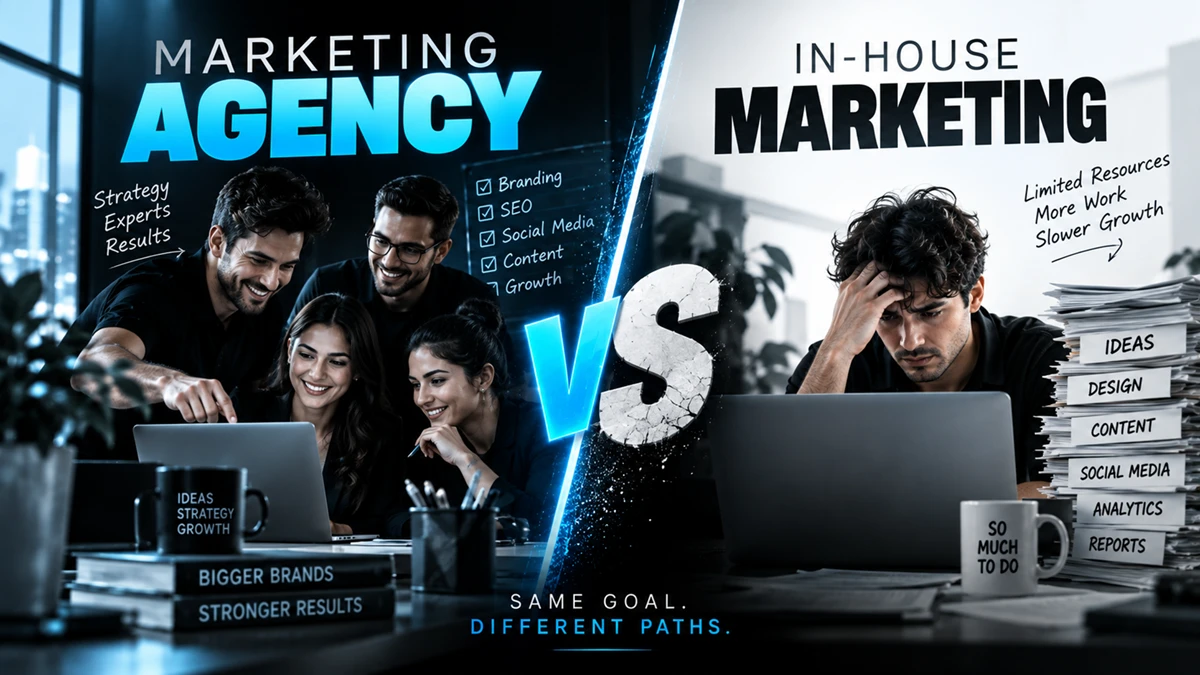
- Agencies bring specialized expertise across branding, SEO, social, and content — all under one roof.
- Data-driven agency campaigns can return 5-8x more ROI than non-data-driven efforts.
- Outsourcing marketing typically cuts costs by around 30% while improving campaign quality.
- Without external support, brands risk losing up to 70% of potential digital leads.
- A unified, full-service strategy consistently outperforms fragmented in-house efforts.
With a Marketing Agency
What changes when specialized experts run your marketing strategy.
1. Availability of Specialized Expertise
Agencies bring dedicated experts in branding, digital marketing, SEO, social media, and content creation — meaning every part of a brand's strategy gets handled by someone who specializes in exactly that discipline, not a generalist stretched thin.
2. Creative Innovation
Agencies aren't emotionally attached to a brand's old ideas — they bring fresh perspectives that internal teams often miss simply because they're too close to the work.
3. Time and Cost Efficiency
Outsourcing marketing removes the overhead of hiring, training, and managing a full in-house team — freeing up both budget and internal bandwidth.
4. Data-Driven Strategies
Agencies rely on analytics to optimize every campaign, ensuring marketing spend is directed toward what's actually working, not what feels right.
5. Scalability and Flexibility
Agencies flex marketing effort up or down based on business need — no hiring cycles required to scale a campaign for a big launch or slow down during quieter periods.
6. Full-Service 360° Marketing Solutions
Integrated strategy across web design, content, SEO, social, and video creates one cohesive brand experience — instead of disconnected efforts pulling in different directions.
Without a Marketing Agency
What tends to happen when marketing stays fully in-house, without external expertise.
1. Lack of Expertise
Relying only on in-house or DIY marketing often means campaigns lack strategic depth — well-intentioned, but not built on the specialized knowledge that drives real competitiveness.
2. Stale Creativity
Without external input, marketing tends to repeat familiar patterns — and consumers notice fast when content feels disconnected from what's current.
3. Higher Long-Term Costs
In-house marketing without specialized tools or expertise often becomes more expensive over time, not less — inefficiency compounds quietly across every campaign.
4. Poor Use of Time
Managing all marketing internally pulls focus away from core business priorities — growth slows not because the strategy is wrong, but because attention is split too thin.
5. Missed Online Growth
Digital platforms evolve fast, and in-house teams without dedicated focus often fall behind — missing opportunities that a specialized team would catch early.
The Bottom Line, Side by Side
Frequently Asked Questions
Is a full agency partnership worth it for small or early-stage brands?
Often yes — even part-time or project-based agency support can close the expertise gap that costs small brands the most in lost engagement and inefficient spend.
Can a brand combine in-house and agency marketing?
Yes, and many do. A hybrid model — in-house for day-to-day brand voice, agency for strategy, data, and specialized execution — is common and often the most cost-effective.
How is agency ROI actually measured against in-house spend?
Typically through comparing cost-per-acquisition, engagement rate, and campaign conversion data over the same period — the numbers above reflect industry-wide averages from that kind of comparison.
The numbers make the case pretty clearly — specialized expertise, data-backed decisions, and a unified strategy consistently outperform fragmented in-house efforts. Where does your brand currently sit on this spectrum — fully in-house, agency-supported, or somewhere in between? Let us know in the comments.
Discussion (0)
Leave a Reply
No comments yet. Be the first to start the discussion!